Building a Kubernetes operator in Go: automating SPIFFE workload registration
In the previous post I registered SPIFFE entries by hand with spire-server entry create. Here I build a Kubernetes operator that automates it — a controller-runtime reconciler that watches Deployments and registers them with the SPIRE Entry API, finalizer cleanup and Prometheus metrics included.
In the previous post I gave workloads a zero trust identity with SPIFFE and SPIRE — and registered every workload entry by hand with spire-server entry create. That's fine for a demo and untenable in production: a human typing CLI commands does not scale to hundreds of services that come and go on every deploy.
This problem is already solved, officially. The SPIRE project ships spire-controller-manager, an operator that reconciles ClusterSPIFFEID custom resources into SPIRE registration entries — if you need automated workload registration in production, use that. This post instead rebuilds a simplified version of the same idea as a learning exercise, to understand controller-runtime and the SPIRE Entry API from the inside.
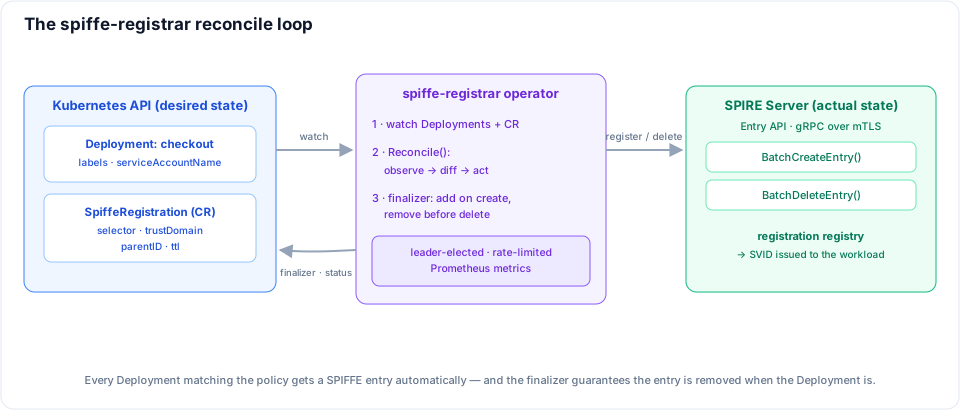
The proof of concept is an operator called spiffe-registrar that watches Deployments and registers them with SPIRE automatically. Every new Deployment gets a SPIFFE ID without anyone touching the CLI, and when a Deployment is deleted its entry is cleaned up. It's built on controller-runtime, calling the SPIRE Entry API over gRPC — essentially the same machinery the official operator uses, scaled down to something you can read end to end.
Why operators exist
kubectl is for humans. You observe the cluster, decide what should change and apply it. An operator is that same loop, automated: a program that watches the Kubernetes API, compares the world to the desired state and acts to close the difference — forever, without you.
That's the whole idea, the control loop: observe current state, compare to desired state, act, repeat. Kubernetes itself is built from these loops — the Deployment controller reconciles ReplicaSets, the ReplicaSet controller reconciles Pods. An operator extends the same machinery to your domain. Ours reconciles "Deployments" against "SPIRE entries".
When should you write one? When the gap between desired and actual state needs ongoing, automated reconciliation that no existing tool covers — provisioning external state from Kubernetes objects, in this case SPIRE registration entries. If a Helm chart or a one-off Job does the job, use those. Reach for an operator when the work is continuous and event-driven, not a one-time apply.
The reassuring part: an operator is just a Go program watching the Kubernetes API. There's no magic. controller-runtime gives you the caching, the work queue and the leader election; you write the function that decides what to do.
What I'm building
spiffe-registrar introduces one custom resource, SpiffeRegistration, which is a policy: it says "for Deployments matching this selector, register a SPIFFE entry under this trust domain". A single policy covers many Deployments — that's the design that scales, rather than one custom resource per workload.
apiVersion: registrar.example.com/v1alpha1
kind: SpiffeRegistration
metadata:
  name: prod-workloads
spec:
  trustDomain: example.org
  parentID: spiffe://example.org/ns/spire-system/sa/spire-agent
  ttl: 1h
  namespaceSelector:
    matchLabels:
      spiffe.io/registrar: enabled
  deploymentSelector: {}        # all Deployments in matching namespaces
The operator watches Deployments. For each Deployment a policy selects, it derives the SPIFFE ID from the namespace and service account — spiffe://example.org/ns/prod/sa/checkout — and calls the SPIRE Entry API to create the entry with the k8s:ns and k8s:sa selectors. This automates exactly what I did manually with:
spire-server entry create \
  -parentID spiffe://example.org/ns/spire-system/sa/spire-agent \
  -spiffeID spiffe://example.org/ns/prod/sa/checkout \
  -selector k8s:ns:prod \
  -selector k8s:sa:checkout
On deletion, a finalizer ensures the entry is removed before Kubernetes lets the Deployment go.
Project setup with controller-runtime
I'll use controller-runtime directly rather than scaffolding with the full kubebuilder CLI — it's fewer moving parts and makes the wiring explicit. Start a module and pull the dependencies:
go mod init github.com/example/spiffe-registrar
module github.com/example/spiffe-registrar

go 1.22

require (
	github.com/prometheus/client_golang v1.19.0
	github.com/spiffe/go-spiffe/v2 v2.3.0
	github.com/spiffe/spire-api-sdk v1.9.6
	google.golang.org/grpc v1.64.0
	k8s.io/api v0.29.3
	k8s.io/apimachinery v0.29.3
	k8s.io/client-go v0.29.3
	sigs.k8s.io/controller-runtime v0.17.3
)
The layout is the conventional one — API types, the controller, and a thin main:
spiffe-registrar/
├── cmd/main.go                       # manager wiring + SPIRE client
├── api/v1alpha1/                      # CRD Go types
│   ├── groupversion_info.go
│   └── spiffe_registration_types.go
├── internal/controller/              # the reconciler
│   └── deployment_controller.go
└── config/{crd,rbac}/                # generated manifests
Two code-generation tools do the boilerplate — deepcopy methods, the CRD YAML and the RBAC ClusterRole — and setup-envtest provides the API-server binaries for tests:
go install sigs.k8s.io/controller-tools/cmd/controller-gen@v0.14.0
go install sigs.k8s.io/controller-runtime/tools/setup-envtest@latest
Defining the CRD in Go
The API group registration is small:
// api/v1alpha1/groupversion_info.go
// +kubebuilder:object:generate=true
// +groupName=registrar.example.com
package v1alpha1

import (
	"k8s.io/apimachinery/pkg/runtime/schema"
	"sigs.k8s.io/controller-runtime/pkg/scheme"
)

var (
	GroupVersion  = schema.GroupVersion{Group: "registrar.example.com", Version: "v1alpha1"}
	SchemeBuilder = &scheme.Builder{GroupVersion: GroupVersion}
	AddToScheme   = SchemeBuilder.AddToScheme
)
The resource itself. The kubebuilder markers drive validation, the status subresource and the printer columns — controller-gen turns them into the CRD's OpenAPI schema:
// api/v1alpha1/spiffe_registration_types.go
package v1alpha1

import metav1 "k8s.io/apimachinery/pkg/apis/meta/v1"

type SpiffeRegistrationSpec struct {
	// TrustDomain is the SPIFFE trust domain entries are created under.
	// +kubebuilder:validation:Required
	// +kubebuilder:validation:MinLength=1
	TrustDomain string `json:"trustDomain"`

	// ParentID is the agent/node-alias SPIFFE ID that parents the entries.
	// +kubebuilder:validation:Required
	// +kubebuilder:validation:Pattern=`^spiffe://.+`
	ParentID string `json:"parentID"`

	// TTL is the X.509-SVID lifetime for registered workloads.
	// +kubebuilder:default="1h"
	// +optional
	TTL metav1.Duration `json:"ttl,omitempty"`

	// NamespaceSelector selects namespaces in scope. Nil matches all.
	// +optional
	NamespaceSelector *metav1.LabelSelector `json:"namespaceSelector,omitempty"`

	// DeploymentSelector further filters Deployments by label. Nil matches all.
	// +optional
	DeploymentSelector *metav1.LabelSelector `json:"deploymentSelector,omitempty"`
}

type SpiffeRegistrationStatus struct {
	// +optional
	Conditions []metav1.Condition `json:"conditions,omitempty"`
	// +optional
	LastSyncTime *metav1.Time `json:"lastSyncTime,omitempty"`
	// +optional
	ObservedGeneration int64 `json:"observedGeneration,omitempty"`
}

// +kubebuilder:object:root=true
// +kubebuilder:subresource:status
// +kubebuilder:resource:scope=Cluster,shortName=sreg
// +kubebuilder:printcolumn:name="Trust Domain",type=string,JSONPath=`.spec.trustDomain`
// +kubebuilder:printcolumn:name="Age",type=date,JSONPath=`.metadata.creationTimestamp`
type SpiffeRegistration struct {
	metav1.TypeMeta   `json:",inline"`
	metav1.ObjectMeta `json:"metadata,omitempty"`

	Spec   SpiffeRegistrationSpec   `json:"spec,omitempty"`
	Status SpiffeRegistrationStatus `json:"status,omitempty"`
}

// +kubebuilder:object:root=true
type SpiffeRegistrationList struct {
	metav1.TypeMeta `json:",inline"`
	metav1.ListMeta `json:"metadata,omitempty"`
	Items           []SpiffeRegistration `json:"items"`
}

func init() {
	SchemeBuilder.Register(&SpiffeRegistration{}, &SpiffeRegistrationList{})
}
Then generate the deepcopy methods and the CRD/RBAC manifests:
controller-gen object paths=./api/...
controller-gen crd rbac:roleName=spiffe-registrar \
  paths=./... output:crd:dir=config/crd output:rbac:dir=config/rbac
Writing the reconciler
This is the core. The reconciler's primary object is the Deployment — that's what triggers work — and a SpiffeRegistration policy decides whether a given Deployment is in scope. The controller holds a SPIRE EntryClient injected at startup.
First the type, constants and the custom metrics, registered into controller-runtime's Prometheus registry so they're served on the manager's metrics endpoint:
// internal/controller/deployment_controller.go
package controller

import (
	"context"
	"fmt"
	"time"

	"github.com/prometheus/client_golang/prometheus"
	entryv1 "github.com/spiffe/spire-api-sdk/proto/spire/api/server/entry/v1"
	"github.com/spiffe/spire-api-sdk/proto/spire/api/types"
	"github.com/spiffe/go-spiffe/v2/spiffeid"
	"google.golang.org/grpc/codes"

	appsv1 "k8s.io/api/apps/v1"
	corev1 "k8s.io/api/core/v1"
	apimeta "k8s.io/apimachinery/pkg/api/meta"
	metav1 "k8s.io/apimachinery/pkg/apis/meta/v1"
	"k8s.io/apimachinery/pkg/labels"

	ctrl "sigs.k8s.io/controller-runtime"
	"sigs.k8s.io/controller-runtime/pkg/client"
	"sigs.k8s.io/controller-runtime/pkg/controller/controllerutil"
	"sigs.k8s.io/controller-runtime/pkg/handler"
	logf "sigs.k8s.io/controller-runtime/pkg/log"
	"sigs.k8s.io/controller-runtime/pkg/metrics"
	"sigs.k8s.io/controller-runtime/pkg/reconcile"

	registrarv1alpha1 "github.com/example/spiffe-registrar/api/v1alpha1"
)

const (
	finalizerName     = "registrar.example.com/entry-cleanup"
	entryIDAnnotation = "registrar.example.com/entry-id"
)

var (
	registrationTotal = prometheus.NewCounterVec(prometheus.CounterOpts{
		Name: "spiffe_registration_total",
		Help: "SPIFFE workload entries successfully registered, by namespace.",
	}, []string{"namespace"})

	registrationErrors = prometheus.NewCounterVec(prometheus.CounterOpts{
		Name: "spiffe_registration_errors_total",
		Help: "SPIFFE registration failures, by namespace.",
	}, []string{"namespace"})
)

func init() {
	metrics.Registry.MustRegister(registrationTotal, registrationErrors)
}

// DeploymentReconciler registers selected Deployments with SPIRE.
type DeploymentReconciler struct {
	client.Client
	Entry entryv1.EntryClient
}
Now Reconcile. The finalizer pattern is the part to get exactly right: add the finalizer before you create remote state, and remove it only after the remote state is gone — in every path that drops the finalizer, including when a Deployment merely falls out of scope because a policy changed. Miss one path and you leak SPIRE entries:
func (r *DeploymentReconciler) Reconcile(ctx context.Context, req ctrl.Request) (ctrl.Result, error) {
	log := logf.FromContext(ctx)

	var deploy appsv1.Deployment
	if err := r.Get(ctx, req.NamespacedName, &deploy); err != nil {
		return ctrl.Result{}, client.IgnoreNotFound(err)
	}

	policy, err := r.matchingPolicy(ctx, &deploy)
	if err != nil {
		return ctrl.Result{}, err
	}
	if policy == nil {
		// Out of scope — clean up any entry registered on a previous pass,
		// then drop the finalizer. Removing the finalizer without deleting
		// the entry would leak it when a policy is deleted or a namespace
		// label changes.
		if controllerutil.ContainsFinalizer(&deploy, finalizerName) {
			if err := r.deleteEntry(ctx, &deploy); err != nil {
				registrationErrors.WithLabelValues(deploy.Namespace).Inc()
				return ctrl.Result{}, err
			}
			controllerutil.RemoveFinalizer(&deploy, finalizerName)
			return ctrl.Result{}, r.Update(ctx, &deploy)
		}
		return ctrl.Result{}, nil
	}

	// --- deletion path: clean up the SPIRE entry, then release the object ---
	if !deploy.DeletionTimestamp.IsZero() {
		if controllerutil.ContainsFinalizer(&deploy, finalizerName) {
			if err := r.deleteEntry(ctx, &deploy); err != nil {
				registrationErrors.WithLabelValues(deploy.Namespace).Inc()
				return ctrl.Result{}, err // requeue: never drop the finalizer on failure
			}
			controllerutil.RemoveFinalizer(&deploy, finalizerName)
			if err := r.Update(ctx, &deploy); err != nil {
				return ctrl.Result{}, err
			}
			log.Info("removed SPIRE entry", "deployment", req.NamespacedName)
		}
		return ctrl.Result{}, nil
	}

	// --- create/update path: finalizer first, then remote state ---
	if controllerutil.AddFinalizer(&deploy, finalizerName) {
		if err := r.Update(ctx, &deploy); err != nil {
			return ctrl.Result{}, err
		}
	}

	entryID, err := r.ensureEntry(ctx, policy, &deploy)
	if err != nil {
		registrationErrors.WithLabelValues(deploy.Namespace).Inc()
		r.setCondition(ctx, policy, metav1.ConditionFalse, "RegistrationFailed", err.Error())
		// Back off and retry rather than hot-looping on a failing SPIRE server.
		return ctrl.Result{RequeueAfter: 30 * time.Second}, err
	}

	// Record the entry ID on the Deployment for idempotency + cleanup.
	if deploy.Annotations[entryIDAnnotation] != entryID {
		if deploy.Annotations == nil {
			deploy.Annotations = map[string]string{}
		}
		deploy.Annotations[entryIDAnnotation] = entryID
		if err := r.Update(ctx, &deploy); err != nil {
			return ctrl.Result{}, err
		}
	}

	registrationTotal.WithLabelValues(deploy.Namespace).Inc()
	r.setCondition(ctx, policy, metav1.ConditionTrue, "Registered",
		fmt.Sprintf("registered %s/%s", deploy.Namespace, deploy.Name))
	log.Info("registered workload", "entryID", entryID)

	// Re-sync periodically so drift (a manually deleted entry) self-heals.
	return ctrl.Result{RequeueAfter: time.Minute}, nil
}
The SPIRE calls live in two helpers. ensureEntry is idempotent — BatchCreateEntry returns AlreadyExists (and the existing entry) if it's already there, which I treat as success. One known limitation of that shortcut: a later change to the policy's TTL never propagates to existing entries, because the create call short-circuits. A fuller implementation would compare the returned entry against the desired spec and call BatchUpdateEntry on drift:
func (r *DeploymentReconciler) ensureEntry(
	ctx context.Context, policy *registrarv1alpha1.SpiffeRegistration, deploy *appsv1.Deployment,
) (string, error) {
	sa := serviceAccount(deploy)
	sid, err := spiffeid.FromString(
		fmt.Sprintf("spiffe://%s/ns/%s/sa/%s", policy.Spec.TrustDomain, deploy.Namespace, sa))
	if err != nil {
		return "", fmt.Errorf("build spiffe id: %w", err)
	}
	parent, err := spiffeid.FromString(policy.Spec.ParentID)
	if err != nil {
		return "", fmt.Errorf("invalid parentID: %w", err)
	}

	ttl := int32(policy.Spec.TTL.Duration.Seconds())
	if ttl == 0 {
		ttl = 3600
	}

	entry := &types.Entry{
		SpiffeId: &types.SPIFFEID{TrustDomain: sid.TrustDomain().Name(), Path: sid.Path()},
		ParentId: &types.SPIFFEID{TrustDomain: parent.TrustDomain().Name(), Path: parent.Path()},
		Selectors: []*types.Selector{
			{Type: "k8s", Value: "ns:" + deploy.Namespace},
			{Type: "k8s", Value: "sa:" + sa},
		},
		X509SvidTtl: ttl,
	}

	resp, err := r.Entry.BatchCreateEntry(ctx, &entryv1.BatchCreateEntryRequest{
		Entries: []*types.Entry{entry},
	})
	if err != nil {
		return "", fmt.Errorf("BatchCreateEntry rpc: %w", err)
	}

	res := resp.Results[0]
	switch codes.Code(res.Status.Code) {
	case codes.OK, codes.AlreadyExists:
		return res.Entry.Id, nil // the existing entry is returned on AlreadyExists
	default:
		return "", fmt.Errorf("entry rejected: %s (%s)", res.Status.Message, codes.Code(res.Status.Code))
	}
}

func (r *DeploymentReconciler) deleteEntry(ctx context.Context, deploy *appsv1.Deployment) error {
	entryID := deploy.Annotations[entryIDAnnotation]
	if entryID == "" {
		return nil // nothing was ever registered
	}
	resp, err := r.Entry.BatchDeleteEntry(ctx, &entryv1.BatchDeleteEntryRequest{Ids: []string{entryID}})
	if err != nil {
		return fmt.Errorf("BatchDeleteEntry rpc: %w", err)
	}
	if c := codes.Code(resp.Results[0].Status.Code); c != codes.OK && c != codes.NotFound {
		return fmt.Errorf("delete rejected: %s (%s)", resp.Results[0].Status.Message, c)
	}
	return nil // NotFound is fine — the entry is already gone
}
And the small helpers — policy matching against namespace and Deployment labels, and the status condition:
func (r *DeploymentReconciler) matchingPolicy(
	ctx context.Context, deploy *appsv1.Deployment,
) (*registrarv1alpha1.SpiffeRegistration, error) {
	var policies registrarv1alpha1.SpiffeRegistrationList
	if err := r.List(ctx, &policies); err != nil {
		return nil, err
	}
	var ns corev1.Namespace
	if err := r.Get(ctx, client.ObjectKey{Name: deploy.Namespace}, &ns); err != nil {
		return nil, err
	}
	for i := range policies.Items {
		p := &policies.Items[i]
		if selectorMatches(p.Spec.NamespaceSelector, ns.Labels) &&
			selectorMatches(p.Spec.DeploymentSelector, deploy.Labels) {
			return p, nil
		}
	}
	return nil, nil
}

func selectorMatches(sel *metav1.LabelSelector, set map[string]string) bool {
	if sel == nil {
		return true
	}
	s, err := metav1.LabelSelectorAsSelector(sel)
	if err != nil {
		return false
	}
	return s.Matches(labels.Set(set))
}

func serviceAccount(deploy *appsv1.Deployment) string {
	if sa := deploy.Spec.Template.Spec.ServiceAccountName; sa != "" {
		return sa
	}
	return "default"
}

func (r *DeploymentReconciler) setCondition(
	ctx context.Context, policy *registrarv1alpha1.SpiffeRegistration,
	status metav1.ConditionStatus, reason, msg string,
) {
	apimeta.SetStatusCondition(&policy.Status.Conditions, metav1.Condition{
		Type:    "Registered",
		Status:  status,
		Reason:  reason,
		Message: msg,
	})
	now := metav1.Now()
	policy.Status.LastSyncTime = &now
	policy.Status.ObservedGeneration = policy.Generation
	_ = r.Status().Update(ctx, policy) // best-effort; the next reconcile retries
}
A caveat on shared identities
The SPIFFE ID is derived from the namespace and service account — its selectors are k8s:ns and k8s:sa — so it is per service account, not per Deployment. Two Deployments sharing a service account map to the same SPIFFE ID and the same SPIRE entry. That is correct SPIFFE modelling, but it makes the naive delete-on-Deployment-delete above unsafe: deleting one Deployment would pull the entry out from under a sibling that still needs it. In production, either give each workload its own service account (good practice regardless), or ref-count before deleting — only call BatchDeleteEntry once no remaining Deployment selects that SPIFFE ID. The code above assumes one workload per service account; say so in your SpiffeRegistration docs, or add the ref-count guard first.
Old way vs new way
Manually, every new service meant a human running spire-server entry create, and every deleted service meant remembering to run entry delete — which nobody did, so the registry filled with stale entries pointing at workloads that no longer existed. With the operator, registration is a side effect of kubectl apply and de-registration is guaranteed by the finalizer. The CLI commands didn't go away; they just stopped being a human's job.
Registering the controller
SetupWithManager wires the watches. It reconciles Deployments, and also watches SpiffeRegistration so that editing a policy re-evaluates every Deployment it could now match.
One production insight worth more than the code: do not reach for GenerationChangedPredicate here. It filters out updates that don't bump .metadata.generation — but a deletion (setting deletionTimestamp) and the controller's own finalizer writes are metadata-only changes. Filter on generation and the controller will silently never see deletions, and your cleanup never runs. I watch the full stream and filter cheaply inside Reconcile instead.
//+kubebuilder:rbac:groups=apps,resources=deployments,verbs=get;list;watch;update;patch
//+kubebuilder:rbac:groups="",resources=namespaces,verbs=get;list;watch
//+kubebuilder:rbac:groups=registrar.example.com,resources=spifferegistrations,verbs=get;list;watch
//+kubebuilder:rbac:groups=registrar.example.com,resources=spifferegistrations/status,verbs=get;update;patch
//+kubebuilder:rbac:groups=registrar.example.com,resources=spifferegistrations/finalizers,verbs=update
func (r *DeploymentReconciler) SetupWithManager(mgr ctrl.Manager) error {
return ctrl.NewControllerManagedBy(mgr).
Named("spiffe-registrar").
For(&appsv1.Deployment{}).
Watches(
®istrarv1alpha1.SpiffeRegistration{},
handler.EnqueueRequestsFromMapFunc(r.deploymentsForPolicy),
).
Complete(r)
}
// deploymentsForPolicy re-queues every Deployment when a policy changes.
func (r *DeploymentReconciler) deploymentsForPolicy(ctx context.Context, _ client.Object) []reconcile.Request {
var deploys appsv1.DeploymentList
if err := r.List(ctx, &deploys); err != nil {
return nil
}
reqs := make([]reconcile.Request, 0, len(deploys.Items))
for i := range deploys.Items {
reqs = append(reqs, reconcile.Request{NamespacedName: client.ObjectKeyFromObject(&deploys.Items[i])})
}
return reqs
}
The RBAC markers above generate the ClusterRole. Note the verbs: the controller needs update;patch on deployments (to write the finalizer and the entry-ID annotation), get;list;watch on namespaces (for namespace-label matching), and the standard status/finalizers subresource permissions on its own CRD.
main wires the manager and — the bit specific to this operator — builds the SPIRE EntryClient. The operator authenticates to the SPIRE server with its own SVID over mTLS, using the go-spiffe gRPC credentials. That SVID needs an admin entry, which you bootstrap once: spire-server entry create -admin -spiffeID spiffe://example.org/ns/spire-system/sa/spiffe-registrar .... One manual entry to bootstrap the automation of all the others.
// cmd/main.go
package main

import (
	"flag"
	"os"

	"github.com/spiffe/go-spiffe/v2/spiffeid"
	"github.com/spiffe/go-spiffe/v2/spiffegrpc/grpccredentials"
	"github.com/spiffe/go-spiffe/v2/spiffetls/tlsconfig"
	"github.com/spiffe/go-spiffe/v2/workloadapi"
	entryv1 "github.com/spiffe/spire-api-sdk/proto/spire/api/server/entry/v1"
	"google.golang.org/grpc"

	"k8s.io/apimachinery/pkg/runtime"
	utilruntime "k8s.io/apimachinery/pkg/util/runtime"
	clientgoscheme "k8s.io/client-go/kubernetes/scheme"
	ctrl "sigs.k8s.io/controller-runtime"
	"sigs.k8s.io/controller-runtime/pkg/healthz"
	"sigs.k8s.io/controller-runtime/pkg/log/zap"
	metricsserver "sigs.k8s.io/controller-runtime/pkg/metrics/server"

	registrarv1alpha1 "github.com/example/spiffe-registrar/api/v1alpha1"
	"github.com/example/spiffe-registrar/internal/controller"
)

var (
	scheme   = runtime.NewScheme()
	setupLog = ctrl.Log.WithName("setup")
)

func init() {
	utilruntime.Must(clientgoscheme.AddToScheme(scheme))
	utilruntime.Must(registrarv1alpha1.AddToScheme(scheme))
}

func main() {
	var metricsAddr, probeAddr, spireServer, spireSocket string
	var enableLeaderElection bool
	flag.StringVar(&metricsAddr, "metrics-bind-address", ":8080", "")
	flag.StringVar(&probeAddr, "health-probe-bind-address", ":8081", "")
	flag.BoolVar(&enableLeaderElection, "leader-elect", true, "Enable leader election.")
	flag.StringVar(&spireServer, "spire-server", "spire-server.spire-system.svc.cluster.local:8081", "")
	flag.StringVar(&spireSocket, "spire-socket", "unix:///run/spire/agent-sockets/agent.sock", "")
	flag.Parse()

	ctrl.SetLogger(zap.New())
	ctx := ctrl.SetupSignalHandler()

	// The operator's own SVID, used as an admin client to the SPIRE Entry API.
	source, err := workloadapi.NewX509Source(ctx,
		workloadapi.WithClientOptions(workloadapi.WithAddr(spireSocket)))
	if err != nil {
		setupLog.Error(err, "create X509 source")
		os.Exit(1)
	}
	defer source.Close()

	serverID := spiffeid.RequireFromString("spiffe://example.org/spire/server")
	conn, err := grpc.NewClient(spireServer,
		grpc.WithTransportCredentials(
			grpccredentials.MTLSClientCredentials(source, source, tlsconfig.AuthorizeID(serverID))))
	if err != nil {
		setupLog.Error(err, "dial SPIRE server")
		os.Exit(1)
	}
	defer conn.Close()

	mgr, err := ctrl.NewManager(ctrl.GetConfigOrDie(), ctrl.Options{
		Scheme:                 scheme,
		Metrics:                metricsserver.Options{BindAddress: metricsAddr},
		HealthProbeBindAddress: probeAddr,
		LeaderElection:         enableLeaderElection,
		LeaderElectionID:       "spiffe-registrar.registrar.example.com",
	})
	if err != nil {
		setupLog.Error(err, "create manager")
		os.Exit(1)
	}

	if err := (&controller.DeploymentReconciler{
		Client: mgr.GetClient(),
		Entry:  entryv1.NewEntryClient(conn),
	}).SetupWithManager(mgr); err != nil {
		setupLog.Error(err, "set up controller")
		os.Exit(1)
	}

	_ = mgr.AddHealthzCheck("healthz", healthz.Ping)
	_ = mgr.AddReadyzCheck("readyz", healthz.Ping)

	setupLog.Info("starting manager")
	if err := mgr.Start(ctx); err != nil {
		setupLog.Error(err, "manager exited")
		os.Exit(1)
	}
}
Testing
Controllers are tested against a real API server with envtest — it boots etcd and kube-apiserver locally, no kubelet, no nodes. The SPIRE side is a fake EntryClient so the test asserts what the controller asked SPIRE to do without a running SPIRE server. Embedding the generated interface gives no-op defaults for the methods the test doesn't exercise:
type fakeEntryClient struct {
	entryv1.EntryClient
	created []*types.Entry
	deleted []string
}

func (f *fakeEntryClient) BatchCreateEntry(
	_ context.Context, in *entryv1.BatchCreateEntryRequest, _ ...grpc.CallOption,
) (*entryv1.BatchCreateEntryResponse, error) {
	f.created = append(f.created, in.Entries...)
	return &entryv1.BatchCreateEntryResponse{
		Results: []*entryv1.BatchCreateEntryResponse_Result{{
			Status: &types.Status{Code: int32(codes.OK)},
			Entry:  &types.Entry{Id: "entry-abc123", SpiffeId: in.Entries[0].SpiffeId},
		}},
	}, nil
}

func (f *fakeEntryClient) BatchDeleteEntry(
	_ context.Context, in *entryv1.BatchDeleteEntryRequest, _ ...grpc.CallOption,
) (*entryv1.BatchDeleteEntryResponse, error) {
	f.deleted = append(f.deleted, in.Ids...)
	return &entryv1.BatchDeleteEntryResponse{
		Results: []*entryv1.BatchDeleteEntryResponse_Result{{Status: &types.Status{Code: int32(codes.OK)}}},
	}, nil
}
The create-path test: apply a policy and a matching Deployment, reconcile, and assert SPIRE was called with the right SPIFFE ID and the finalizer was added.
func TestReconcile_RegistersDeployment(t *testing.T) {
	fake := &fakeEntryClient{}
	r := &controller.DeploymentReconciler{Client: k8sClient, Entry: fake}

	// (namespace "prod" labelled spiffe.io/registrar=enabled and the policy
	// were created in TestMain via envtest's k8sClient)
	deploy := newDeployment("prod", "checkout", "checkout-sa")
	require.NoError(t, k8sClient.Create(ctx, deploy))

	_, err := r.Reconcile(ctx, reconcile.Request{
		NamespacedName: client.ObjectKeyFromObject(deploy),
	})
	require.NoError(t, err)

	require.Len(t, fake.created, 1)
	require.Equal(t, "example.org", fake.created[0].SpiffeId.TrustDomain)
	require.Equal(t, "/ns/prod/sa/checkout-sa", fake.created[0].SpiffeId.Path)

	var got appsv1.Deployment
	require.NoError(t, k8sClient.Get(ctx, client.ObjectKeyFromObject(deploy), &got))
	require.True(t, controllerutil.ContainsFinalizer(&got, "registrar.example.com/entry-cleanup"))
	require.Equal(t, "entry-abc123", got.Annotations["registrar.example.com/entry-id"])
}
The update path re-runs the same reconcile and asserts BatchCreateEntry is idempotent (no duplicate entry); the delete path sets a deletionTimestamp, reconciles, and asserts fake.deleted contains the entry ID and the finalizer is gone. Once the unit tests pass, deploy it to a real cluster, kubectl apply a Deployment in a labelled namespace, and watch the entry appear with spire-server entry show — then delete the Deployment and watch it vanish.
Production considerations
This POC stops short of production, but these are the concerns that decide whether any operator like it is ready for it — the same ones the official spire-controller-manager has to answer:
- Leader election — always on. Run two or three replicas for availability, but only the leader reconciles. Without
LeaderElection: true, every replica would race to create and delete the same SPIRE entries. It's one field; never ship without it. - Finalizers on objects you don't own. Writing a finalizer onto user Deployments is what guarantees cleanup — but it also means that if the operator is down, those Deployments can't be deleted until it recovers. That's the trade-off for guaranteed de-registration. Monitor the operator's liveness, alert on it, and keep a documented break-glass for emergencies:
kubectl patch deployment X -p '{"metadata":{"finalizers":[]}}' --type=merge. - Rate limiting.
controller-runtimequeues failed reconciles through a default exponential back-off limiter (≈5ms up to ≈1000s). Returning anerrorfromReconcileuses it; returningRequeueAfterschedules a fixed retry. I useRequeueAfter: 30 * time.Secondon SPIRE failures so a flaky server doesn't hammer itself, and a one-minute steady-state re-sync so a manually deleted entry self-heals. - Metrics you get for free. The manager already exposes
controller_runtime_reconcile_total,controller_runtime_reconcile_errors_totalandcontroller_runtime_reconcile_time_secondsper controller — enough to alert on reconcile error rate and p99 latency. The customspiffe_registration_totalandspiffe_registration_errors_totaladd the domain view: registrations and failures per namespace. Scrape both from the same Prometheus you already run. Registration availability belongs in the identity layer's error budget: if the operator is down, new workloads can't get an identity at all.
Conclusion
Put the two posts together and you have the full picture: SPIFFE and SPIRE give every workload a short-lived, attested identity, and this operator makes that identity automatic — registration is a side effect of deploying, de-registration is guaranteed by a finalizer, and a human never touches spire-server entry create again. Manual CLI commands don't scale. Control loops do.
And to restate the framing from the top: spiffe-registrar is a learning build, inspired by the SPIRE project's own spire-controller-manager. I wrote it to understand controller-runtime and the SPIRE Entry API mechanics, not to replace the official tool — if you're rolling this out for real, deploy spire-controller-manager. The concepts carry over directly: the same reconcile loop, the same Entry API, the same trade-offs.
Elsewhere in this series: the SPIFFE/SPIRE identity layer this operator automates, zero-downtime Kubernetes upgrades to keep the cluster current, and Karpenter and spot instances to run it affordably.
Related posts
From branch to production: automating multi-environment deployments with GitHub Actions and Argo CD on EKS
How I run 20+ developer environments plus testing, staging and production across two AWS accounts with one standalone deploy-pipeline repo whose workflow every microservice reuses — GitHub Actions building images, self-hosted runners reaching private EKS, and per-cluster Argo CD doing the syncs. On-demand dev deploys, auto-drafted releases and a branch-to-production promotion flow that never rebuilds the artefact.
Implementing zero trust workload identity with SPIFFE/SPIRE on Kubernetes
Static API keys and shared secrets don't scale, and they all hit the Secret Zero problem. Here's how SPIFFE and SPIRE give every workload a short-lived, attested identity on Kubernetes — with working manifests, go-spiffe mTLS and the operational considerations the quickstarts skip.
Building an AI platform on Kubernetes
Once three teams have each rebuilt GPU scheduling, model serving and RAG plumbing, you don't have an AI strategy — you have three. Here's how to turn that into one paved road on Kubernetes: a gateway, a serving layer, GPU compute and the cross-cutting concerns that make it production-grade.