Private networking on AWS for GDPR and ISO 27001 compliance
How to design an AWS VPC that keeps workloads private, auditable and aligned with GDPR, ISO 27001 and PCI-DSS — using private subnets, VPC endpoints, flow logs and Terraform.
When auditors ask "how is this data protected in transit?" and "prove nothing in this subnet can reach the internet," vague answers don't pass. GDPR, ISO 27001 and PCI-DSS all care about the same network fundamentals: isolation, least privilege, encryption and an audit trail. This is how I design AWS VPCs so those answers are built in — and provable — rather than bolted on.
The core principle: private by default
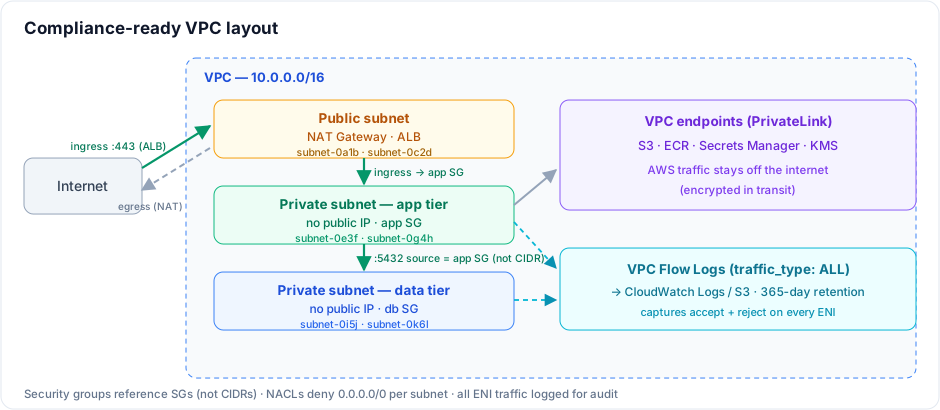
Workloads that handle sensitive data should have no path to or from the public internet unless one is explicitly justified. In a compliant VPC that means:
- Application and database tiers live in private subnets with no public IPs.
- Outbound internet (for patches, APIs) goes through a NAT gateway in a public subnet — egress only, never ingress.
- Internal AWS service traffic (S3, ECR, Secrets Manager) never touches the internet at all — it goes through VPC endpoints.
Subnet tiering with Terraform
Separate tiers into separate subnets so security groups and NACLs can enforce boundaries between them. The data tier should never be directly reachable from the internet-facing tier without going through the app tier.
resource "aws_subnet" "private_app" {
  count             = 2
  vpc_id            = aws_vpc.main.id
  cidr_block        = cidrsubnet(aws_vpc.main.cidr_block, 8, count.index + 10)
  availability_zone = data.aws_availability_zones.available.names[count.index]

  # never auto-assign public IPs in a private tier
  map_public_ip_on_launch = false

  tags = { Tier = "app", Compliance = "in-scope" }
}

resource "aws_subnet" "private_data" {
  count                   = 2
  vpc_id                  = aws_vpc.main.id
  cidr_block              = cidrsubnet(aws_vpc.main.cidr_block, 8, count.index + 20)
  availability_zone       = data.aws_availability_zones.available.names[count.index]
  map_public_ip_on_launch = false

  tags = { Tier = "data", Compliance = "in-scope" }
}
Keep AWS traffic off the internet: VPC endpoints
By default, a private instance calling s3.amazonaws.com or Secrets Manager routes out through the NAT gateway and across the public internet to AWS's public endpoints. Auditors flag this. VPC endpoints (PrivateLink) keep that traffic inside the AWS network.
Use a Gateway endpoint for S3 and DynamoDB (free, route-table based) and Interface endpoints for everything else:
# Gateway endpoint — S3 stays on the AWS backbone
resource "aws_vpc_endpoint" "s3" {
  vpc_id            = aws_vpc.main.id
  service_name      = "com.amazonaws.${var.region}.s3"
  vpc_endpoint_type = "Gateway"
  route_table_ids   = aws_route_table.private[*].id
}

# Interface endpoint — Secrets Manager over PrivateLink
resource "aws_vpc_endpoint" "secretsmanager" {
  vpc_id              = aws_vpc.main.id
  service_name        = "com.amazonaws.${var.region}.secretsmanager"
  vpc_endpoint_type   = "Interface"
  subnet_ids          = aws_subnet.private_app[*].id
  security_group_ids  = [aws_security_group.endpoints.id]
  private_dns_enabled = true
}
With private_dns_enabled, the SDK call to secretsmanager.<region>.amazonaws.com resolves to a private VPC IP automatically — no code changes. This single control satisfies a lot of "encryption in transit" and "no public data path" requirements at once.
Least privilege: security groups over NACLs
Security groups are stateful and reference each other — make them your primary control. Reference SGs by ID, not CIDR, so the rule expresses intent ("the data tier accepts traffic from the app tier") rather than a brittle IP range.
resource "aws_security_group_rule" "db_from_app" {
  type                     = "ingress"
  from_port                = 5432
  to_port                  = 5432
  protocol                 = "tcp"
  security_group_id        = aws_security_group.data.id
  source_security_group_id = aws_security_group.app.id   # not a CIDR
  description              = "PostgreSQL from app tier only"
}
Use NACLs as a coarse, subnet-level backstop — e.g. explicitly denying the data subnet any route to 0.0.0.0/0. They're stateless and harder to reason about, so keep their rules few and blunt.
The audit trail: VPC Flow Logs
You can't prove what you don't record. VPC Flow Logs capture accepted and rejected connections — the evidence auditors ask for, and the data you need when investigating an incident. Send them to CloudWatch or S3 with a retention period that matches your framework (PCI-DSS wants a year, with 3 months immediately available).
resource "aws_flow_log" "vpc" {
  vpc_id          = aws_vpc.main.id
  traffic_type    = "ALL"
  log_destination = aws_cloudwatch_log_group.flow_logs.arn
  iam_role_arn    = aws_iam_role.flow_logs.arn
}

resource "aws_cloudwatch_log_group" "flow_logs" {
  name              = "/vpc/flow-logs"
  retention_in_days = 365
}
Pair this with a GuardDuty detector — it consumes flow logs, DNS logs and CloudTrail to flag things like a private instance suddenly talking to a known-malicious IP or a crypto-mining domain. That's continuous monitoring evidence with almost no operational cost.
Encryption in transit
Network isolation is necessary but not sufficient — most frameworks also want data encrypted on the wire, even inside the VPC.
- TLS everywhere, including service-to-service. Terminate at the ALB with an ACM certificate, and re-encrypt to the backend rather than passing plaintext over the last hop.
- VPC endpoints are TLS to the AWS service by default.
- For database connections, enforce SSL at the engine level (e.g. RDS
rds.force_ssl = 1) so a misconfigured client can't silently connect in plaintext.
Mapping it back to the frameworks
The same handful of controls answers the recurring audit questions:
- Private subnets, no public IPs → network segmentation / isolation
- Security groups referencing SGs → least-privilege access
- VPC endpoints (PrivateLink) → no public data path, encryption in transit
- Flow logs with retention → audit trail and monitoring
- GuardDuty → continuous threat detection
- TLS + enforced DB SSL → encryption in transit
Make it provable, not just present
The final piece is drift detection. A compliant VPC on day one means nothing if someone attaches an internet gateway to a private route table six months later. Run AWS Config rules — vpc-flow-logs-enabled, vpc-sg-open-only-to-authorized-ports, restricted-ssh — so a violation is flagged automatically, and keep the whole VPC in Terraform so every change is reviewed in a pull request and recorded in version control.
Compliance in networking isn't a one-time audit scramble. Build the controls into the infrastructure code, log everything and let Config and GuardDuty prove continuously that the controls are still in place.
Related posts
Spot instances in production: when to use them, when not to and how to maintain availability
When spot instances are the right call, when not to use them at all, and how to keep a service available even as AWS reclaims nodes underneath it. A workload-by-workload model with the reasoning behind each decision.
Reducing Kubernetes costs by 35% with Karpenter and spot instances
How we cut an EKS compute bill by roughly a third — replacing static node groups with Karpenter, running the stateless majority on spot and letting consolidation reclaim idle capacity, without trading away reliability.
Kubernetes and Cloudflare Tunnel: Zero Trust private networking without a public IP
How to expose Kubernetes services securely using Cloudflare Tunnel and Zero Trust, with no open inbound ports.